API security
API Penetration Testing
Operator-led testing focused on authorization, scopes, and workflow abuse. We prove impact with exploit chains and close with retest evidence in the Bytium workspace.
- Manual authorization testing across endpoints
- Exploit chains proven with real tokens and flows
- Retests included for verified closure
What you get on day one
Concise scope, test plan, and outcomes your team can execute.
3–5 days
Start-to-test window
Access ready? We move fast.
OAuth2/JWT/HMAC
Auth models covered
Also API keys + custom schemes.
Broken access control
Primary risk focus
BOLA/IDOR, scopes, workflow abuse.
72 hours
Retest turnaround
Per confirmed fix.
The API operator briefing your backend team expects.
We test the API as an untrusted client. We validate object-level authorization, scope enforcement, and workflow integrity, then prove impact with exploit chains and replayable request/response evidence.
Lead operator
Advanced offensive cert track (OSCP/OSWE/OSEP/OSED/OSCE-level).
Senior
Peer review
Every critical finding reviewed before release.
Yes
Evidence quality
Requests, responses, traces, steps.
Replayable
Closure
Retest evidence attached per fix.
Verified
Attack paths
Role, object, scope, and workflow coverage.
Mapped
Impact clarity
Business/context plus exploitability.
Explicit
Owners + notes
Who fixes what, with guidance.
Assigned
Retest plan
Safe window + status in briefing.
Tracked
What you’ll know by week one
Clear answers, not endpoint lists
Exploitability
Which endpoints and flows are actually breakable
Scope safety
Where scopes/claims drift or fail to enforce correctly
Workflow abuse
Which state transitions can be bypassed or replayed
Integration risk
Where partner trust and webhooks amplify impact
Strong fit when
Real-world API complexity exists
- Authorization models are complex or evolving
- Multiple clients exist (web, mobile, internal)
- Partner integrations or webhooks are critical
- You need retest-verified closure evidence
Outcome: fewer surprises at release
You get exploit-backed priorities (who can do what with which token), engineering-ready proof, and retest closure evidence that stands up to leadership and audit review.
What we test
Risk coverage that matches real attacks
We test the paths attackers actually take—identity, access, workflows, integrations—and show proof with real requests and responses. We follow attacker movement instead of endpoint lists: who can access which objects, how workflows get pushed out of bounds, and where integrations are abused.
Common failure patterns we validate
Practical checks that catch real incidents without flooding you with noise.
Authentication & token handling
Token replay, refresh abuse, session confusion, key rotation gaps, weak signing/verification.
Authorization & object access
BOLA/IDOR across endpoints, tenant boundary escape, role and ownership enforcement failures.
Scopes, claims & permissions
Over-broad scopes, missing checks, scope escalation, claim tampering, inconsistent enforcement.
Business logic & state abuse
Workflow bypass, order-of-operations flaws, race conditions, replay attacks, idempotency gaps.
Enumeration & abuse controls
Rate-limit bypass, brute force, resource exhaustion, predictable identifiers, excessive data exposure.
Integrations & internal trust
Partner APIs, webhooks, backend-to-backend assumptions, signing validation, SSRF-like pivots.
How we test
The API exploit playbook
A repeatable approach that produces fewer false positives and clearer fixes.
Phase 01
Auth & role mapping
We model roles, scopes, tenants, and tokens the way your real clients use them (web, mobile, partner).
Phase 02
Endpoint + object discovery
We enumerate resources and object relationships (including hidden endpoints and inconsistent versions).
Phase 03
Authorization pressure testing
We probe object access, scope enforcement, and tenant boundaries across every relevant path.
Phase 04
Workflow + state abuse
We attack ordering, replay, idempotency, and business rules where the highest-impact issues live.
Phase 05
Exploit chains + evidence
We chain issues to prove real impact, then package proof engineers can replay without guesswork.
Phase 06
Retest to verified closure
Fixes get retested and recorded with updated evidence - so closure is defensible.
Delivery platform
Credibility you can see
Endpoint-level findings, proof, owners, and retests - kept live until closure is verified.
Engineers can replay requests and traces. Leadership can track readiness. Auditors get closure proof - all tied to the same findings and approvals in the workspace.
What “premium” looks like in practice
Evidence stays attached to each finding and retest outcome. No hunting across docs, screenshots, and chat threads.
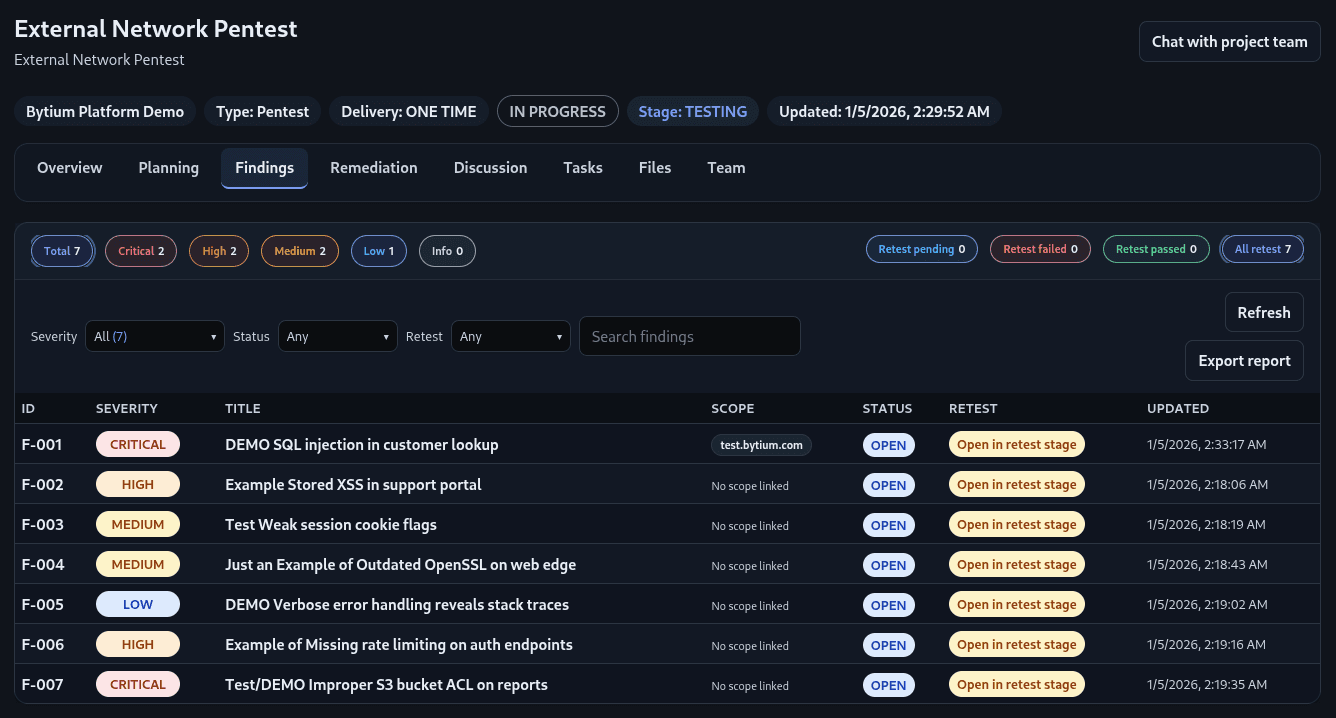
Delivery workspace (live)
Endpoint-level findings with request/response proof, ownership, and retest closure - kept live during the engagement.
Ready when you are
Start an API penetration test
We’ll scope your endpoints, test real attacker paths, and verify fixes with retest evidence.
Deliverables
Evidence that backend teams can use immediately
Replayable request/response proof, exploit narratives, and ownership tracked with retests until closure.
Technical findings with API PoCs
Concrete request/response steps, payloads, and traces.
Fix guidance engineers can apply
Patterns for access control, scope checks, and safe workflow handling.
Exploit narratives across endpoints
How an attacker moves from one weakness to real business impact.
Executive summary + closure evidence
Risk and readiness plus retest-backed proof for review.
Endpoint-level findings board
Filter by severity, owner, status, and exploitability during the engagement.
Request/response evidence per finding
Replayable steps with redacted tokens, traces, and screenshots.
Ownership + remediation tracking
Assign owners, track fix progress, and keep release readiness visible.
Retest requests + results history
Retests are tracked per fix with updated closure proof.
One evidence trail, multiple audiences
Engineering gets reproducible proof. Leadership gets readiness signals. Auditors get closure evidence.
Engagement options
Pick the cadence that fits your API change rate
Both options include retests and evidence that stays attached to each finding.
One-time API Pentest
A focused engagement for a release, audit checkpoint, or partner onboarding.
- Defined scope + timeline
- Endpoint PoCs + exploit narratives
- Included retest to verify fixes
Best when you have a launch date or audit window.
API PTaaS
Release-aligned cadence with scheduled windows and rolling retests as endpoints evolve.
- Windows per sprint/quarter
- Evidence stays tied to findings
- Retests tracked to closure
Best when endpoints change frequently and assurance must stay current.
FAQ
Before we start
Do you need OpenAPI/Swagger?
It helps, but it’s not required. We can work from Postman collections, docs, or live discovery.
Can you test internal APIs?
Yes - internal APIs often carry the highest risk due to trust assumptions and weaker abuse controls.
Do you test mobile-only APIs?
Yes. We model the mobile client flows and test how attackers craft requests outside the app.
Do you test GraphQL?
Yes. We test resolver authorization, field-level controls, query cost limits, and introspection exposure.
Staging vs production?
Staging with production-like data is preferred; production is possible with guardrails and approvals.